Thursday, 4 February 2016

Bon bons #2 & #3

For those who collect wooden puzzles and/or puzzle boxes, then you know about which designer these puzzles come from: Perry McDaniel! Who else?

I have already reviewed the previous Bon bons puzzles, but without any review of the last 2, the review of the Bon bons puzzles would not be complete ;-)

Bon bons #2 and #3 on the top row
I really like these nice and small puzzles, because all the moves are very well hidden thanks to the great and precise job Perry did.

These 2 puzzles take more moves than the first two.

About Bon bons #2, the first move is very well hidden, I like it a lot, then you need to discover the next steps. I find the moves a little bit tight compared to the very smooth moves of Bon bons #2.
The colors of this puzzles fit well together.


About Bon bons #3, this is the most difficult puzzles of the Bon bons: there are a lot of moves, and each move is a very small move (like 1mm) and thus the moves are pretty tight. But the quality is nonetheless very good!


If I would rank the Bon bons puzzles, my favourite would be #1 and my less favourite would be #3.

Perry crafted the cake puzzles and the Bon bons puzzles. Maybe next puzzles will be the pie puzzles, or another puzzle cake from the "Puzzled guy bakery" ;-)

Thursday, 28 January 2016

Kamei's X-Mas present for 2015: Box with a ribbon 3

For 2015 Kamei decided to make another version of his 2 previous versions of the "box with a ribbon" puzzle.
Can somebody tell me why they (some karakuri's designers) always try to make a first version, and then many others??....Is that because first version was not good enough? Or just a lazily lack of imagination to create something totally new? Actually that's a good question. I like when some different version of the puzzles are released like confetto box 1 and 2 (but they are absolutely good puzzle), but only if the mechanism is not turned to something way too easy after previous versions.

I have not played with the previous versions of this puzzle so I cannot comment and will just describe my feeling about this puzzle.


This puzzle is nicely crafted, everything works as intended and I do not think this can jam over time.
It's composed of a lid and a box with a nice wodden ribbon on the top. Two kind of woods are used and we can recognize Kamei's signature on the bottom of the box.

The goal is to open the box and, as the name implicitely suggests, you will have to do something with the ribbon to open it. This is a wooden ribbon, so please do not act in the same way as with the ribbons put on your X-mas presents :-)

It took me less than 1 minute to open it: it's very easy and not difficult by any means, even for non puzzlers! Of course, at the beginning you will try "useless things" (whi is part of the puzzling fun), especially because as the fit is very good, everything is well hidden!

The mechanism does its job and is simple....too simple. Even if I like this puzzle I am a bit disappoointed by it. Kamei used to making more complex mechanism with more cleverness into them. Just look at his past designs and you will notice that it's not the same level, unfortunately...

I may give a second chance for Kamei for 2016 because I feel he may craft a "better" puzzle for this year. Hopping that I am right!

But don't make my wrong: I like the puzzle but it could have been much much better!!!

Thursday, 21 January 2016

7 woods, 6 pieces, 1 puzzle !!!


You guess what was the puzzle? Well done! A small wooden puzzle designed by Stewart Coffin, crafted by the talented Lee Krasnow and called "Seven woods".


This puzzle is composed of six pieces that need to be assembled in certain way to get this beautiful geometrical solid. The fit of the pieces is absolutely perfect, which make the assembly pretty tricky. Lee did a great job with the glueing of the pieces and with the cutting. Take care: the pieces are sharp!

The puzzle was presented solved in a nice box:

Humm perhaps we can consider that the puzzle is solved when the pieces are assembled, can't we?
What do you think?

Even the way the pieces are put in the box is very nice and original. This crafter has thought about everything!
This is all the more appreciable that most designers do not sell their puzzles in customized box or display stand. We can only agree on the efforts made by Lee!

The shape of the puzzle and the shape of the pieces reminded me a lot of an origami solid I folded some time ago:


The shapes look the same but for my origami I used 12 squared sheets of paper, and for this puzzle there are only half of the pieces (6). Moreover, if you look carefully at the puzzle you have only one diagonal on the top, whereas you have two for my origami. Thus, maybe the assembly is different...

I assume it would have been pretty the same at the beginning, so I tried to assemble in the same way. First two pieces, ok. Third, fine. Fourth, that's ok. Fifth can be ok but difficult. Last one: impossible!
Usually with origami, it's always the last piece that is difficult to assemble and thus you need to fold it slightly, but that impossible to fold wood pieces :-)
So I failed trying to use the same method which consisted of putting pieces one by one. And if you cannot add one piece after another in a "basic way", then you need to consider other assembly methods, what I did...and it worked! I had an idea and was surprised that it worked very well and smoothly, but again you need to be very precise!


A small hesitation: should I put the puzzle in its box?....For the moment it's in it...What do you prefer?


To conclude: a nice puzzle, which relatively small size does not provide you from having a lot of fun to solve it again and again!

Thursday, 14 January 2016

Lunatic lock: a quick comparison between the original and the mass-produced

Every puzzle collectors, whether they collect metal puzzles and/or trick locks or just puzzles, have already heard at least one about the famous Lunatic lock, a metal lock designed by Gary Foshee.

But most collectors have the Bits&Piece lunatic lock and not the original and thus cannot see the differences between both. My copy was my first trick lock.

Before pointing out the differences, a quick talk about what this puzzle is: a lock of course! But a lock without any hole to put a key and without any key, so a mysterious lock!


So how to open it? Well you can play with the small rod in the center: you can turn it, pull it more or less. You can hear also some pins or other ratling things when you move the lock. Then perhaps you've found out what is inside? If so, that's already a good point.
Even if you know how to solve it, you need good precision, and thus it can take a little bit of time.

Once solved you can see the mechanism: simple, precise and so efficient to make you be "lunatic" :-)

Here we are with the differences: on the left will be the original one and on the right a mass-produced version. The mechanism is exactly the same for both.


The design:
I do not have with me right now the mass-produced one, but it seems that the original lock is a bit bigger.
The main difference is that the name of the lock is written on the lock produced by Bits&Pieces. Honestly I think this is a nice thing and I would have liked to see the name written as well on the lunatic lock crafted by Gary Foshee.


The material used
It's stainless steel for the original lock and some kind of cheap aluminium for the mass-produced.
I always prefer to have the original puzzles because the quality has usually nothing to do with the mass-produced ones. However, I must admit that the material is pretty good for this copy. But I still prefer of course the smooth stainless steel of the original one.


Miscellaneous
For the original one, you will have a small addition, but I cannot say more, otherwise it's not a surprise!


To conclude, this puzzle is a must-have in any collection. If you cannot afford the original version, which is rare and expensive, then you can consider buying a mass-produced version for around 15 euros, which will still do well its "job".

Thursday, 7 January 2016

Kasho's X-Mas present for 2015: Panda

As many of you have already guessed the Panda puzzle was the X-Mas present for 2015 designed and crafted by Kasho. And yes, "Panda" is the official name. All the names are put now in the website.

This wooden puzzle is very cute with its shape and the colors that contrast well.


The finish is very precise as well as the fit.

2015 was my first year when I joined Karakuri club and thus I decided to pick up several X-Mas presents to try what each craftmen have to offer.

Even if I like the design of this puzzle and the fact that -as mentioned in Karakuri's website- we can rotate the nose of the Panda, this is clearly a too easy puzzle! Not a lot of steps are required and normally you should solve it in less than 1 minute.

For the same price I prefer to choose other puzzles like Iwahara's which are more difficult with a more complicated mechanism.

I do not think I will order Kasho again. What about you?


Thursday, 31 December 2015

The oriental toothpick safe

This pretty old puzzle (well it's from 2001, so 14 years ago!) was designed and made by Frank Chambers, with the usual material he used for puzzles: corian.

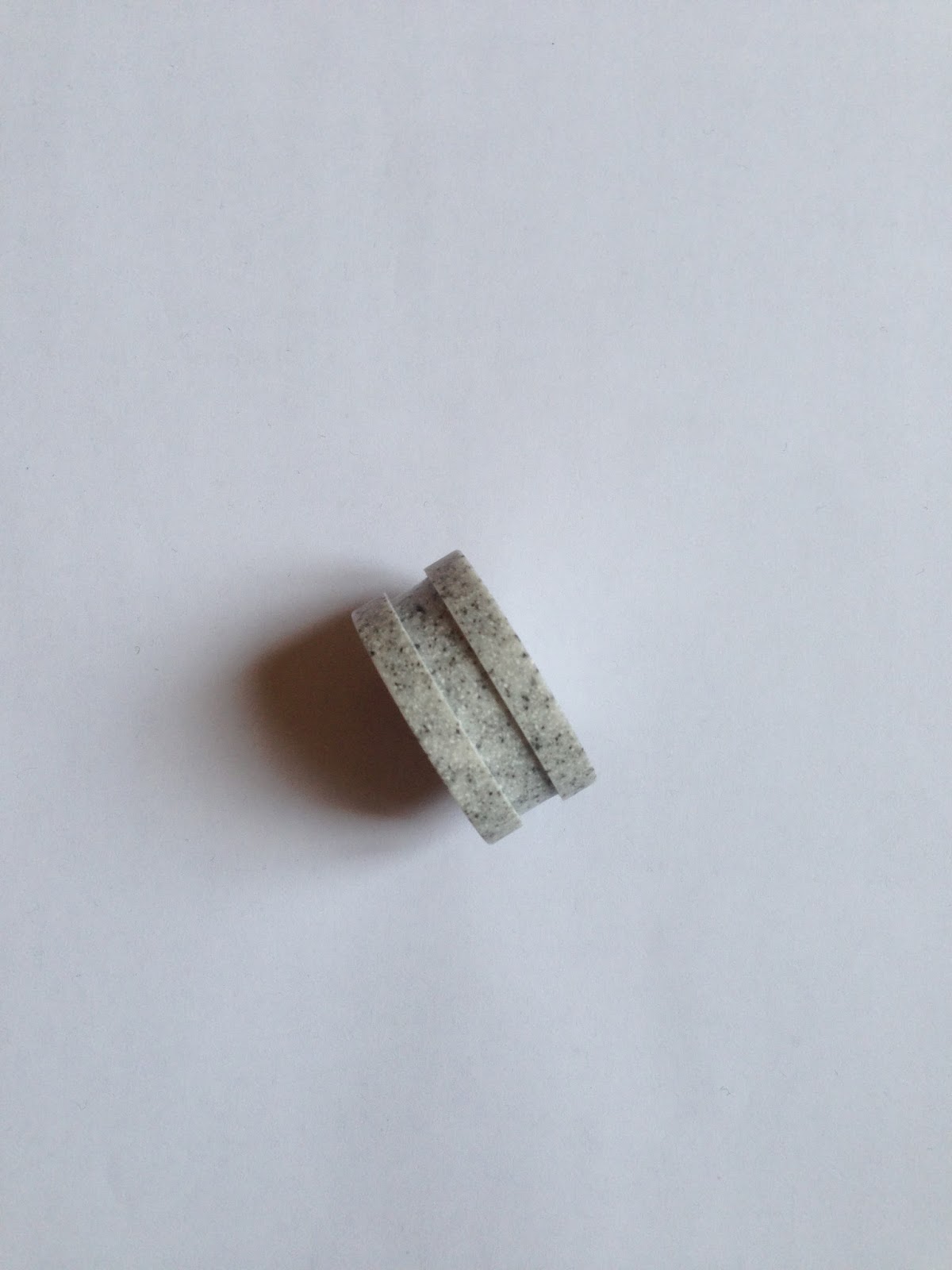
A pretty small puzzle and a quite heavy one regarding its size. The 3 colors of the puzzle are simple but well chosen in my opinion.


There are 2 goals: first one is to open the puzzle, second one is to make a shape with the toothpicks inside (thus the name of the puzzle).

As you can see on the lid is a black button, you can remove it if you want to see the mechanism. It should be glued but it's up to you if you want to glue it or not. I think better not so that you can admire the mechanism many times. And I feel always frustrated not to be able to see the mechanism for some puzzles.

I did not spend long time before managing to open the puzzle. Actually it's not a difficult puzzle and the mechanism is pretty simple, but well implemented.

For the second goal of the puzzle: making the shape with the toothpick is much more difficult.
Well, I would even say it's fetched, very fetched! And even the solution kept me thinking for some time why this was the solution!...It's a strange solution but yes in reality it would work...
You have to really think out of the box to understand it!

Would this hole give any clue?

Thursday, 24 December 2015

Ring box

This small and cute puzzle was designed and crafted by Frank Chambers some time ago, with corian.

The goal is to open the ring box and to find the ring.


This would be more considered as a secret box rather than as a puzzle because it's more a hidden trick than really many steps to open the ring box.

Easy to repeat, not difficult at all to open, but it may take a bit of time (more than 10 seconds...) for a non puzzler because it's very well hidden!

So better to give to your other half tomorrow than to a puzzle collector ;-)
But of course the puzzle collector would appreciate it a lot in his collection!

Thursday, 17 December 2015

Bon bons #1

The puzzled guy bakery baked you something good for your...collection: the bon bons #1

These puzzles are part of a series of 4 small looking-cake puzzles. And the name is very linked to the shapes of them: they are small, but absolutely well crafted and you really need a lot of precision to craft the pannels !!


Your first impression is that the packaging is very nice: you immediately feel hungry :-)
So you open the box and what's inside? 2 small cakes waiting to be eaten! And look each cake is put in a small piece of paper like in a bakery!!!
So then you put the lid of the box under the box because you want to see these puzzles all the time.

Wait....What? Humm it seems that somebody could not wait and ate a part of the small cake!!!
Now you can see the beautiful inside of the cake with colorful layers of...wood. Very very nice.


Is it just a nice piece of art? Or can it be opened? I do not want to spoil so try to figure out what you can do with it :-)

The second cake is also very well crafted and it's different and looks like more a "regular" box. You will have to slide pannels in a precise order to open the box (the inside is too small to put something by the way) and manage to see your serial number with the signature of Perry.

Nice wood

I cannot say better thing that it's very nice, the color of wood is beautiful. It's not a difficult puzzle, you just need to follow a sequence of steps. But the steps are very well hidden and you could miss some steps with your big fingers :-) So I would better rank as a moderately difficult puzzle: the difficulty is due to the size of the puzzle.

I recommend to be careful when playing with these puzzles, because I tend to think that they are more fragile because they are small. The fit may be a bit tight, but do not apply excessive force, otherwise perhaps you could damage some pannels...which would be a pitty.

The other puzzles in the series will be reviewed a bit later.

 To conclude: I am a big fan of Perry's puzzles!!!

Thursday, 10 December 2015

Shake the shaker

Hey you, metal lovers, this is a quick review that may interest you!


So as you may have recognized, this is a metal puzzle designed and made by the mysterious Roger D.

Again, the goal is never given with his puzzles. Sometimes it's obvious, but not with this one. Thus, I cannot put the picture of the puzzle in the solved state because that would spoil a fun part of the puzzle.

So what can you do with this puzzle? Well, you will try the usual techniques and see that it does not work...Indeed this is a very difficult puzzle that requires several steps. You cannot see very well because it's dark inside.
But you can hear things ratling in the puzzle, how can they be useful?....That's the question!


Obviously you will notice that something moves inside the puzzle, and sometime a bit deeper, but still just knowing that you're a bit far from the solution...

Maybe a hint is from the name ("007") ? Maybe it does something unusual and does not do what it seems to be and what the solution you expect to be?

Actually I was a bit surprised by the goal of this puzzle, even a bit disappointed I must admit, you have to know that with Roger D you may be surprised at any point!

However, I do like the puzzle with its original solution, the smooth material and the unique design!


I know who is Roger D ;-)

Thursday, 3 December 2015

Go tamashido!

Sounds Japanese, doesn't it? Well guess what: it's French!

You're provided with a tray, some marbles, a tool and a booklet. The goal is to try to make the shapes shown in the booklet.


As you can notice at a first glance the tray has 2 sides (one triangular and one squared side) with holes inside, but not holes are the same. Some are "regular" holes and some are a bit bigger. And no it's not a default: it's made on purpose of course. One can ask why. Well, because do make the shapes with the marbles you will need to take out some marbles with the magnetic tool, and thus taking marbles from a regular hole can not be possible all the time...

So the challenges begin on which side of the board you want to make the sculptures and from which holes.

The magnetic tool is useful to take out some marbles. It's composed of a stick with a magnet that you can slide. I was sceptical at the beginning because I thought that it could attract all the marbles and make my solids crumble. But it's not the case. First because it's not a powerful magnet, and then because if you slide the magnet you can "cancel" the magnet attraction of the tool. You will need to get used to it, because it's practical. 

I think you can easily guess why the label is "dexterity". Well, not only dexterity but also patience and thinking. But still dexterity because you need to be careful when you take out some marbles with the tools, you need to take the correct marbles, and sometimes the tool becomes useless and you need to use....your hands!


About the difficulty, it's high: you need to think about how you can create the solids, which balls to take out, etc. And the frustration is when you've almost completed the solids but you make it crumble because of a small move....Better not to play outside when it's windy (even a small wind!).

To conclude: a nice game, available HERE. And for the price you're sure to make a good bargain!
My version is the "basic" version but you can have upgraded versions. Just look at the website what they have to offer.

Thursday, 26 November 2015

Gary's escape

Yes this is a pretty old (from 1997) puzzle (which makes it highly collectible!!) designed by Gary Foshee and composed of a bottle, a metal rod and a marble to be freed.


Everything what you need is provided with the puzzle. You just have to take care because, being made with glass, it's fragile.

It's by no mean a difficult puzzle, pretty straight forward, but the ideas are clever. Even if you're not a seasoned puzzler, you immediately know what you have to do, how you will do it and what you expect the result to be. But still you will have pleasure to solve it.


In the solution booklet Gary says to unscrew the bottle to reassemble all the things inside. But if you want a pretty difficult challenge you can try to reassemble it without unscrewing the bottle.

What is your favourite bottle puzzle?

To conclude: this is a nice puzzle and perfect for an exchanged puzzle

Thursday, 19 November 2015

8 star puzzle: the comparision between the prototype and the finished product

This nice-looking puzzle is a design from the Belgium designer Robrecht Louage. I have already reviewed some of his previous puzzles, checked it out!

You may remember the 4 steps puzzle, this is in the same concept but with 4 more steps.

The goal: you put the ball in the "in" hole and you need to free the ball, going through many traps.
Actually there are 8 steps, some of them are clearly visible and some of them are hidden either by black marks or hidden ways.

The first step is easy to go through: just a little bit of dexterity. Same thing for 2nd step but this time it's hidden. If you look well, 2 steps are identical and can be found in Roger D puzzles.

None of the steps can be considered as new principles, thus you will not have any novelty with this puzzle. However, the steps are implemented all the way on your "puzzle journey" and so there is not like "breaks" between them, they are a continuation of each other.

The difficult thing is the maze because even if there are some holes on the back of the puzzles, well you cannot see what you're really doing. You can only try to guess and believe me you should not make big moves, because the different ways are close to each other, with dead-ends and so on: so here it's dexterity in the dark.
Of course, you can unscrew the puzzle and see the maze if you gave up, and then try to navigate again in the maze.

Like usually with puzzles, there is first the prototype and after the finished product. I put below on the left the picture of the prototype and on the right the picture of the finished product, so that you can see the changes.

The front of the puzzle (ok I know the 2 puzzles are not orientated in the same way....my mistake)
For the prototype the plastic is absolutely transparent and a little bit opaque for the finished puzzle, but both have black marks.
I would have prefered that the finished product have a transparent plastic with opaque (and not black) marks, but opaque enough to hide the traps.
The black marks are positioned on the same traps.


The entry of the maze
Nothing different


The back of the puzzle
Again, sorry for the orientation of the puzzle, but I know my readers are clever guys, so you will notice no change, except the name of the puzzle with 2 stars, to make the product totally finished


The inside of the maze
Hummm, no spoiler. But the maze is globally the same but with some small changes, which make the maze of the finished product a bit more difficult, in my opinion.


Solvable and not solvable?
The prototype cannot totally be solved whereas the finished can be, that's normal right ;-)
But this is one of the last steps, so your puzzling experience will not be altered by this small faults. And a prototype is always a high collectible puzzle, isn't it?

To conclude: a very nice puzzle, not difficult but still very enjoyable. Perhaps next puzzle will be the "12 steps puzzle", who knows...


So don't wait too much and buy the puzzle!

If you're lost in the puzzle, look at the solution!!


Thursday, 12 November 2015

3M puzzle

Time to review a packing puzzle by the famous Iwahiro. This puzzle is easy to understand: you need to put all the 3 pieces (with an M shape, hence the name of the puzzle) inside the box. The box and the pieces are made from MDF.


Ok then simple goal, simple solution? Not at all!

If you've already played with any Iwahiro's puzzles like the Jam puzzles or the ODD puzzle, you know that all his puzzles look simple, but actually their solution include either rotations or unusual positions.

As you can see below, the pieces cannot be packed in an usual way, the goal is to pack them so that you can close the box of course!


I play some time with it trying to put them in different ways, and you will notice soon that these pieces interact with each other: just putting one on a vertical plan, the other flat (for example) does not work.

You need to think "outside the box" to put everything inside the box, paradoxical, isn't it? :-)

Once you have figured out the solution, a little dexterity (a very little I would even say) is required.

This puzzle has a satisfaying solution and it will puzzle you for some time I am sure. Iwahiro also designed the 4M puzzle, same goal, but perhaps not the same solution (actually I do not know as I have not yet tried the 4M puzzle, but I would expect a different solution, or at least a slight difference).

If you want an unusual packing puzzle, this is definitely one you should try to get!

Is there anything inside?.... ;-)

Saturday, 7 November 2015

Do you need some light(er)?

Yes yes it's a lighter...but you cannot burn anything with it, or perhaps your brain :-)

Actually it's a puzzle designed and crafted by Roger D, the famous unknown designer (don't you think-like me-that it's a real pitty that nobody knows him?...), all in metal (the flame is in brass, the core is the metal used for many of his puzzles).

The puzzle is not big, but the size is still satisfaying and the weight is not light (you get the pun?)

Looks impressive, doesn't it?


Anyway, let's continue! When you get a Roger D puzzle, actually you have 2 puzzles: the first puzzle is to understand the goal (it's easy to guess it for R2D2 for example), the second puzzle is to solve your metal puzzle.

For this puzzle, I cannot put a picture of the puzzle in the solved state because it would show you the goal of it.

So what would be the goal? Pushing the flame inside the core? Pulling the flame out of the core? Turning the flame? Or perhaps the goal has nothing to do with the flame?...But once you have solved the puzzle, the goal is obvious of course!

Now the solving experience? Humm let's say it's a difficult puzzle. You do not know the goal, you cannot see the internals...So yes, it's difficult: you can experience some pain to solve it! No external tools are required to solve it, by the way.


You can only hear some things ratling inside: but it's difficult to hear if it's only one thing or many things, where they are, and so on.

The cleverness of this puzzle (despite it's natural beauty) is that the mechanism is not super complex: it's rather simple and definitely very well crafted with good precision.

To conclude: a very nice puzzle to play with. It's also very original. I like the design and the solution (I think I found the "official" solution even if no solution are usually published for these puzzles).